


There's a nervous excitement. Apparent is the frosty air coming from my competitors as they perform the "about to run" wiggle on the starting line.
A quick twitch of the hips.
I'm lined up for my local Saturday morning race and I mean business. Three, two, one...
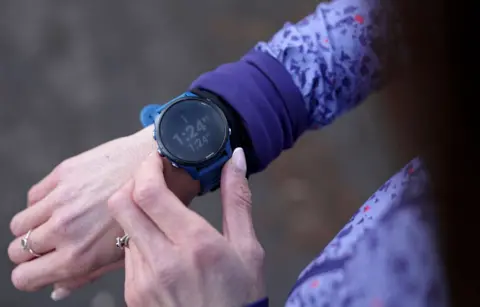
Hold on. I must sort my watch. As does the person beside me.
The person behind us sighs. I'm not moving until… done! Connection established, and I'm running.
In the mele, it's difficult to see a person without a fitness tracker on it. And this extends beyond us runners who use them.
We're witnessing a booming, multi-billion dollar industry. Companies like Apple Watch lead the market, each with an extensive array of diverse versions to cater to a range of budgets. Based on how high tech the model you choose, prices can start from a hundred pounds to thousands of pounds.
"I find it infuriating, it's impossible to switch off."
"It provides solace… It acts as a friend supporting me."
"Please don't notify me I've experienced a poor sleep."
Just some of the reactions I've had from fellow smartwatch wearers when I ask what they think of theirs.
The Data Dilemma
My feelings on my own device? Right now, annoying. It's telling me my speed is wrong, making me wonder whether the foliage I'm running below are disrupting my satellite signal.
Millions of us attach these small gadgets onto our arms and use them constantly, apparently at ease with the fact they're continuously recording us.
Long past are the days when we used them only to give us an idea of our pedometer reading. Now, they can analyse our nightly rest, stress levels, heart rate variability (HRV), our body battery.
It's tricky to find a bodily function they aren't designed to measure.
But are they able to do what they claim to do? And are the numbers we analyse a faithful picture of reality? Do they improve our daily wellness, or do the avalanche of readings and motivational messages just increase our everyday anxiety?

Addiction or Aid?
"I do get a a little fixated with mine," an individual confesses.
While she loves how her device monitors her runs, she finds some of its other capabilities "overwhelming" at times - a feeling initially realised during a pregnancy.
Before she realised she could change its configuration, her smartwatch repeatedly informed her she was not being energetic enough. Now, the watch insists her she's had a bad night's sleep.
"I've got a infant, there's no point to be informed I've not slept," she says. "I know that all too clearly."
Why doesn't she just take it off?
"I could, perhaps, but I've got this love-hate relationship with it," she explains. "I appreciate it for its fitness insights, I just wonder whether all the other things it can now do is maybe too much for me."
The Technology Behind the Tracking
Each model of smartwatch has its own proprietary way of monitoring your health metrics and interpreting your data, but the majority use optical sensors on the back of the watch.
They commonly emit small, green LED lights onto your arm which can detect blood flow, identifying your heartbeat. Sophisticated devices measure changes in the skin conductance that passes over the skin to get an idea of your recovery state.
A Fine Balance
A data scientist says that in general for smartwatches, it's a "fine balance" - while the ever-evolving tech could realistically save lives, "spotting abnormalities before we feel unwell", it could also turn us the tracked into the "concerned but fine".
He points out that some of the latest wearables can perform tests like medical-grade monitoring, which constantly monitor how normal the heart is. They can flag if someone is experiencing a heart arrhythmia, where there is irregular signals in the heart causing an irregular heartbeat.
This does not automatically signal someone is on the verge of a cardiac event, but it can give an advance notice they might be more susceptible of a blood clot in the years to come.
But how to interpret these readings is not straightforward. The expert worries that as further capabilities are added, people may find it hard to fully comprehend their data.
"I remain sceptical that the ability to monitor so many things is such a good idea," he says.
A professor focusing on cardiology echoes this sentiment. Research into the effect of wearable tech on a specific group of cardiovascular patients suggested a minority of those who were given devices to monitor their heart health experienced greater stress and were "more inclined to use medical services".
She observed a pattern with her patients - they noticed a worrying figure on their watch. They became worried. Their pulse rose. They got increasingly anxious. They checked again, and their anxiety went up again.
"If we see data about ourselves that we don't really understand then, naturally, we are going to become concerned," the psychologist says. "We look, we obsess - it becomes a feedback loop."


